Flexible molecule alignment
Aligning small molecules has applications in structure-based binding affinity prediction. For instance, it may be of interest to identify molecules that are similar to one which binds to a specific pocket on the protein; these may also bind, and be of interest when designing medicines.
Alignment in Molchanica is flexible: Both the template and query molecules are flexible: They can rotate around bonds, and their bond lengths flex as required. To start, open the two you wish to align. Then click the Align button in the GUI. This will bring up a window where you can configure the alignment. From here select the two molecules to align, and click Run alignment to start.
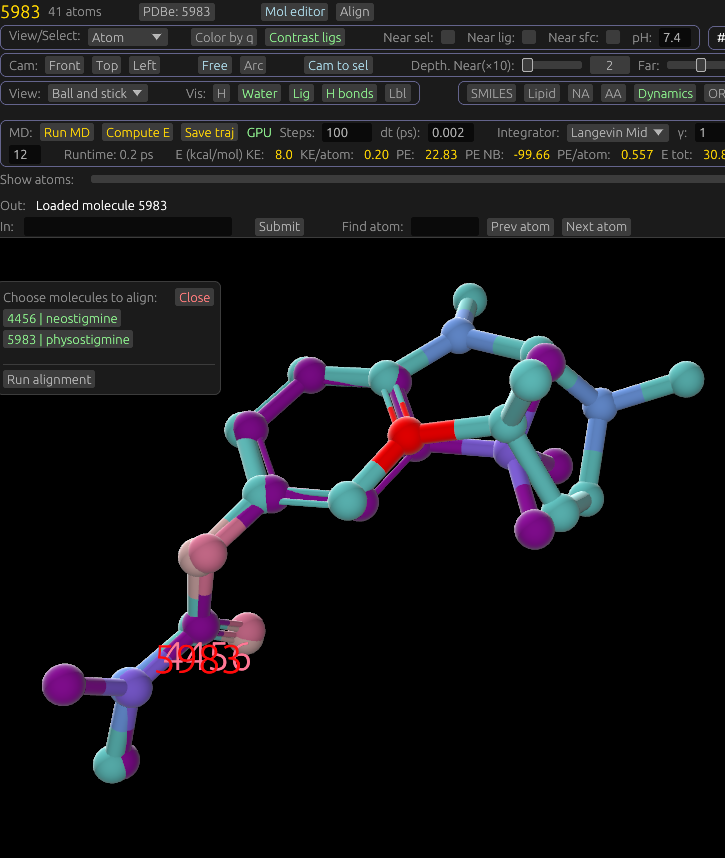
Methodology
We first provide a quick initial alignment pose, we align gross features of the molecules. For example, we match ring centers and planes between molecules for all ring combinations (In both plane orientations), then rotate around this ring until energy is minimized. If one or both molecule lacks rings, we align using bonds between heavy atoms near the molecule's centroid.
We perform the bulk of the alignment using molecular dynamics and energy minimization, using GAFF2 forcefields. We do this using a synthetic potential which takes the following factors into account:
- Element
- Force field type type (GAFF2)
- Type in residue / atom name (?)
- Bond types
- Partial charge
Template and Query molecules
We characterize one molecule as the Template molecule and the other as the Query molecule. A distinction is that the template molecule has no overall position and rotation, but it can rotate around flexible bonds. The query molecule is translated and rotated in order to align with the template.
Note that these are fuzzy distinctions, as both molecules are flexible. It mainly applies to screening many "query" molecules against a template, and in these absolute positions and orientations.
Algorithm details
(todo: Descibe the initial alignment, the synthetic potential, the scoring, and how we manage flexing the template molecule.)
Scoring metrics
We score conformations using the following metrics:
(todo: The atom-analysis score)
Potential energy
We measure the potential energy in both positioned template and query molecules. A lower potential energy may indicate lower internal strain in the molecule, and be a better conformation.
Volume of the overlaid molecules
We construct a mesh surrounding all atoms using the Marching Cubes algorithm, then measure its volume. This is the same algorithm we use for generating the visible solvent-accessible-surface mesh. A lower
References
Wang, 2023: Z-Align Brown, 2020: BCL::MolAlign BCL on Github